
The India aviation industry 2026 is not just growing. It is rewriting itself from the ground up.
Stand on the tarmac of any new Indian airport right now — one that didn’t exist five years ago — and watch what’s happening in real time. A private jet taxis in from Mumbai. A regional turboprop loads passengers heading to a Tier-3 city. A young co-pilot runs her first solo cross-country check. All at the same airport. All in the same hour.
That is the India aviation industry in 2026. And if you are a pilot, a business executive, or someone building a company — you need to understand exactly what is happening and why it matters to you.
Let’s break it down across seven trends that are actively reshaping how India flies.
1. India Aviation Industry 2026: The Market Size Will Shock You
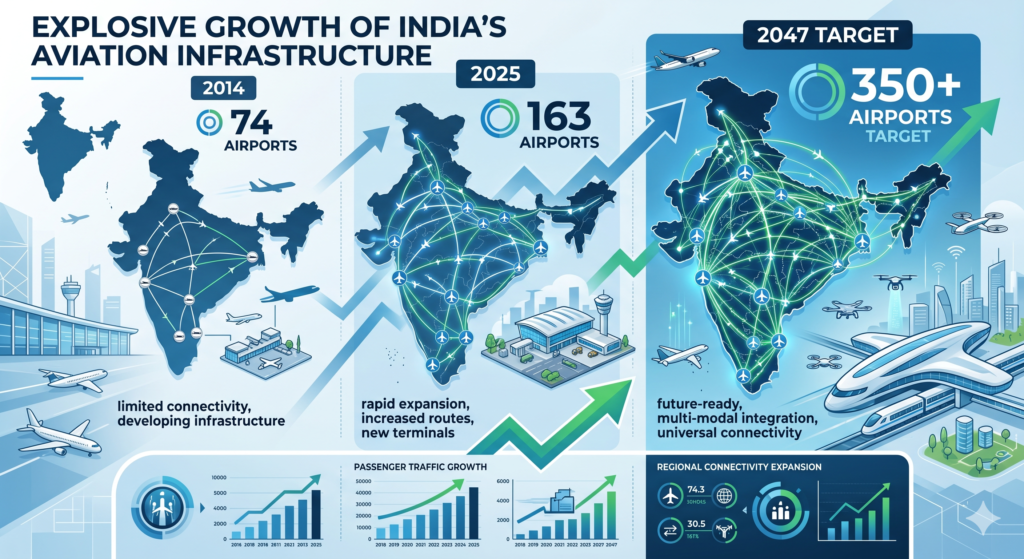
The numbers are extraordinary — and they deserve to be stated plainly.
India’s aviation market was worth $16.24 billion in 2025. It is projected to hit $45.59 billion by 2034, growing at a compound annual rate of 11.72%. That is not airline revenue. That is the total aviation ecosystem — training, MRO, charter, cargo, airports, and defense aviation combined.
India is now the third-largest domestic aviation market on earth. Passenger traffic crossed 237 million in just the first seven months of FY2026. The airport network has more than doubled — from 74 airports in 2014 to 163 airports by late 2025. By 2047, India’s centenary of independence, the government plans to have 350 to 400 airports serving over one billion passengers annually.
This is not a vision document. This is active policy backed by real capital. The Indian government is deploying over $1.83 billion into airport infrastructure and aviation navigation services through 2026. The Airports Authority of India is investing ₹25,000 crore over five years. Navi Mumbai International Airport opened in December 2025. Jewar Airport in Noida is coming online this year.
And Indian airlines? They are ordering aircraft like never before. IndiGo has more than 500 on order. Air India’s historic 470-aircraft order is being delivered now. Indian carriers have collectively placed orders for over 1,700 new planes.
Every one of those planes needs pilots. Maintenance engineers. Ground crew. Charter operators. And aviation entrepreneurs who are ready for what’s coming. India aviation market IBEF industry report
2. India Aviation Industry 2026: Private Jets Hit an All-Time Record
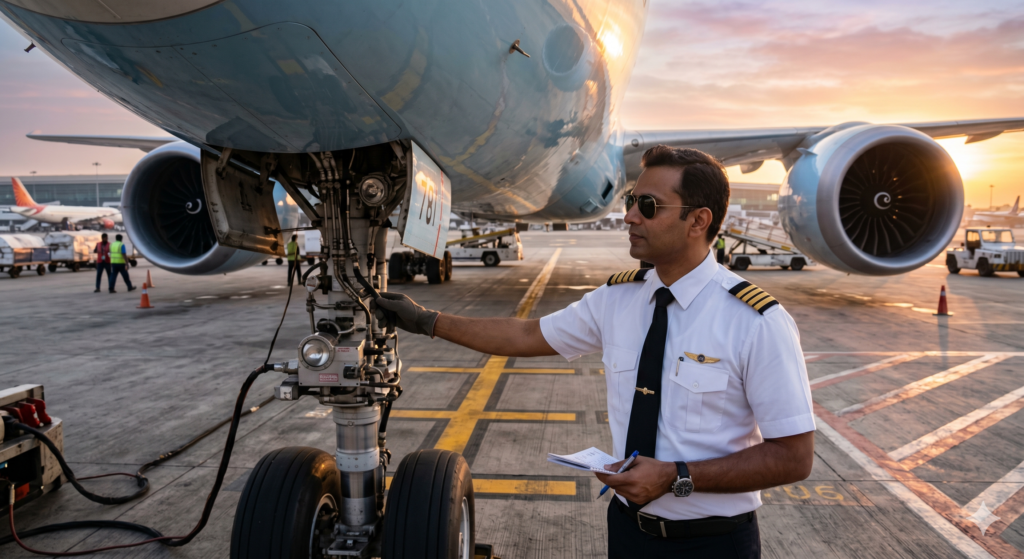
Here is a fact that surprised even veteran aviation analysts: India is now the largest private jet charter fleet in all of Asia-Pacific.
According to the Asian Sky Charter Report, India’s private jet charter fleet surged by a remarkable 53.2% between 2023 and 2025, reaching 121 aircraft — overtaking Australia’s 107 aircraft to claim the top position in the region. During the same period, the Asia-Pacific region’s charter fleet overall grew by just 18.2%.
India didn’t just grow. It absolutely dominated.
Why? The reasons stack up fast. India’s ultra-high-net-worth individual (UHNI) population is expanding rapidly. Corporate executives need direct connections between secondary cities where commercial airlines run limited or inconvenient schedules. Wedding season charter bookings are surging. Medical evacuations. IPL team logistics. Entertainment industry travel. Each use case adds demand that commercial aviation simply cannot serve.
Globally, the picture reinforces India’s trajectory. Private jet activity was about 3% higher in the first half of 2025 compared to 2024, with over 3.9 million business jet flights recorded between January and August 2025. The global private jet charter market, valued at $16.38 billion in 2025, is heading toward $25.79 billion by 2031.
The demand for private charter flight India services is structural, not seasonal. With 1.4 billion people, a growing HNI class, and hundreds of secondary cities still underserved by commercial airlines, the business aviation runway in India is very, very long.
Aerokalinga Aviation Pvt. Ltd. and Blackstar Aerospace — built by operators who understand both the ground-level realities and the strategic opportunity — are positioned exactly where this demand is landing. DGCA commercial pilot licensing India
3. The India Aviation Industry in 2026 Is Facing a Pilot Crisis That Opens Career Doors
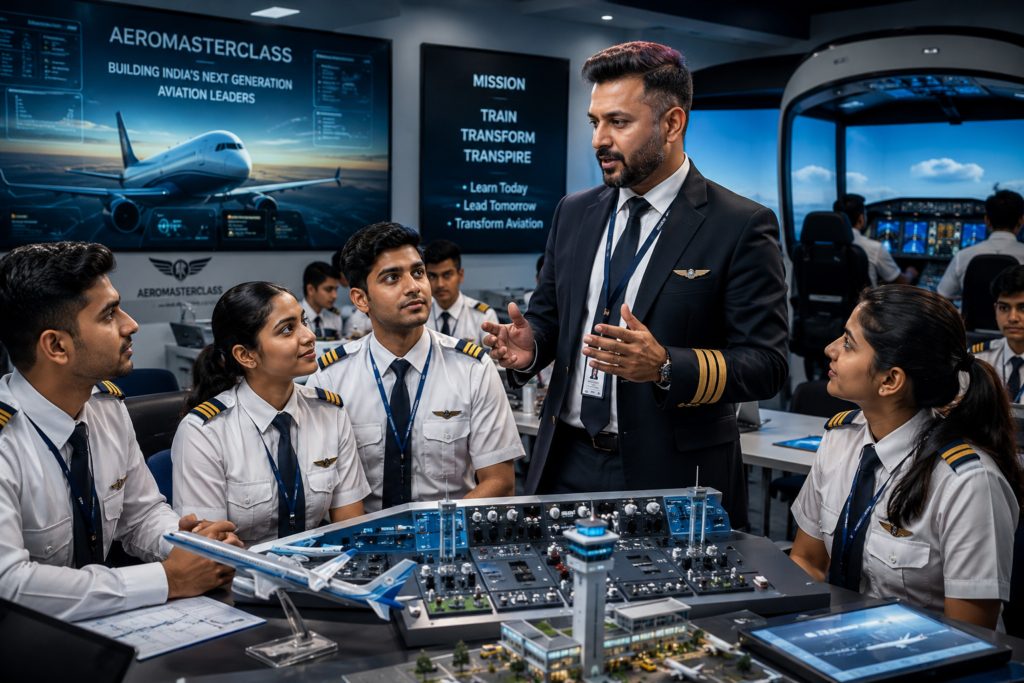
Here is the career truth that most aspiring pilots are not hearing loudly enough: this is the best time in a generation to train as a pilot in India.
The India aviation industry 2026 faces a structural pilot gap. The numbers are staggering. India needs between 35,000 and 40,000 new pilots over the next decade. At least 7,000 of those are needed by 2026 alone. CAPA India projects commercial pilot demand at 22,400 by FY2030. The Civil Aviation Ministry puts the figure even higher.
Yet India currently issues only 1,200 to 1,500 new Commercial Pilot Licenses per year — a fraction of what the industry requires. The math is unavoidable: supply is not keeping up with demand.
The reasons run deep. Airlines are adding aircraft faster than training pipelines can produce crew. Senior captains are retiring at scale. Experienced pilots are leaving for higher-paying carriers in the Middle East. New DGCA Flight Duty Time Limitation rules require larger crew rosters per aircraft. And the UDAN regional connectivity scheme is creating pilot demand in cities that commercial aviation had never reached before.
For aspiring pilots starting training in 2025–2026, the graduation date aligns almost perfectly with the next wave of peak airline recruitment. First officer starting salaries are touching ₹1.5 lakh per month. Experienced captains are earning ₹60 lakh to ₹1 crore annually.
But here’s what separates the hired from the waitlisted: quality of training. Airlines are not short on CPL holders. They are short on airline-ready pilots — professionals with strong type ratings, simulator hours, CRM skills, and cockpit discipline built in from day one.
This is the exact problem that Aeromasterclass was built to solve. Founded with the vision of creating DGCA-ready, career-ready aviation professionals, Aeromasterclass doesn’t train students to pass exams. It trains pilots that airlines actually want to hire.
4. Meet the Entrepreneur Quietly Building India’s Aviation Ecosystem
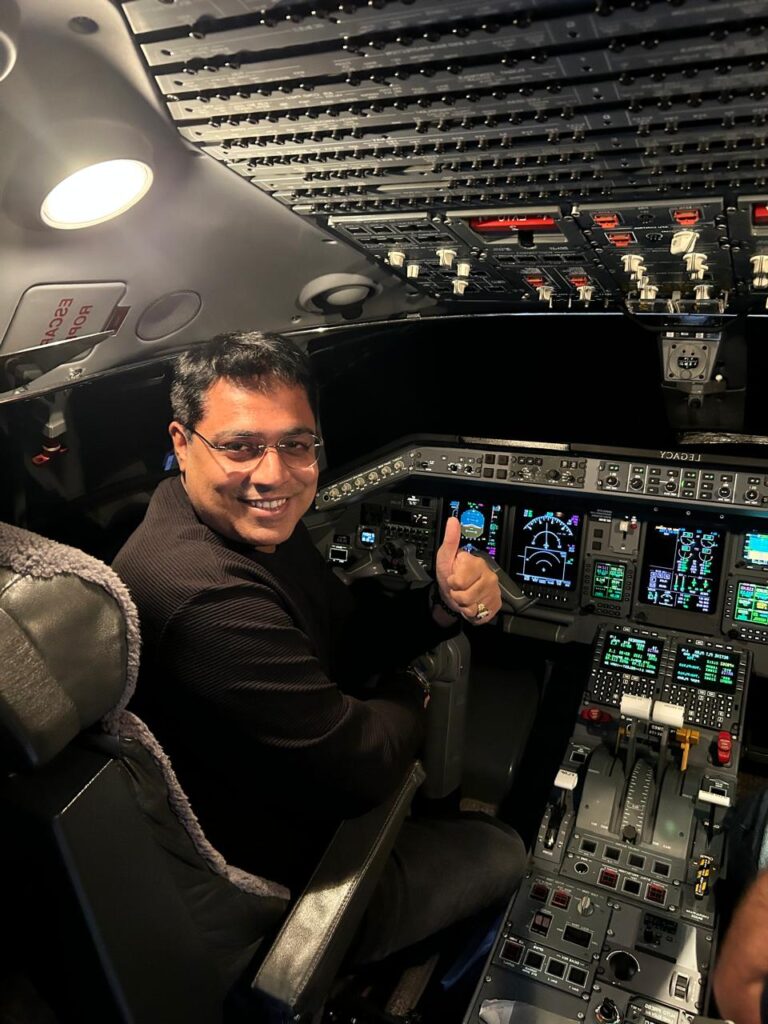
Behind every industry transformation, there are people who saw the future clearly before anyone else believed it was real.
Capt. Sandeep Mishra is one of those people.
A renowned commercial pilot with years of hands-on aviation operations experience, Capt. Mishra has built something that is rare in Indian aviation — an integrated, multi-company ecosystem designed to serve the full value chain of the India aviation industry 2026.
Most operators in Indian aviation pick a lane. They run a training school, or a charter company, or an aerospace firm. Capt. Mishra is building all three — simultaneously — because he understands that India’s aviation opportunity doesn’t live in any single segment. It lives in how those segments connect.
Through Aeromasterclass, he is training the next generation of Indian pilots — not just to clear DGCA exams, but to be truly airline-ready from their very first day of line flying.
Through Aerokalinga Aviation Pvt. Ltd., he is operating business aviation and charter services with the professionalism, safety standards, and operational rigor that corporate clients, HNIs, and medical emergency teams demand.
And through Blackstar Aerospace, he is engaging with the technology frontier of aviation’s future — drones, sustainable aviation, advanced air mobility, defense systems, and aerospace manufacturing — positioning India not just as a consumer of aviation technology, but as a producer of it.
“Aviation entrepreneurship in India is not about flying hours. It’s about vision, courage, and the willingness to build institutions — not just businesses.”
This kind of ecosystem-level thinking is exactly what the India aviation industry 2026 needs most.
5. Business Aviation India: The Segment Most People Are Dangerously Underestimating

Business aviation in India works on fundamentally different logic than commercial aviation.
Where commercial aviation is about volume — moving millions of passengers efficiently — business aviation is about value per seat. A single charter flight can command ₹6 lakh to ₹32 lakh depending on aircraft type, route, and configuration. Air ambulance services — arguably the most essential form of charter aviation — save lives in ways that cannot be assigned a price.
India’s private jet charter costs in 2026 range from ₹1.5 lakh per hour for a turboprop to over ₹12 lakh per hour for an ultra-long-range jet. A Delhi-to-Mumbai flight on a light jet costs approximately ₹13.5 to ₹16 lakh one-way. For a CEO whose time is worth crores per day, those numbers are a rational calculation — not a luxury decision.
And the market is evolving toward even more accessible models. Subscription-based access programs and fractional ownership structures — models that transformed Western business aviation — are gaining real traction in India. More corporate clients are choosing monthly access over one-off bookings. This shift creates recurring revenue for operators and lower effective costs for clients.
As Indian companies expand aggressively into Tier-2 and Tier-3 cities — markets that commercial airlines connect poorly or not at all — business jets are becoming productivity infrastructure. They are not status symbols. They are boardrooms with wings. CAPA India aviation analysis
6. India Aviation Industry 2026 Is Being Powered by Bold Government Policy
No honest analysis of the India aviation industry 2026 leaves out the policy engine driving it.
The UDAN scheme — Ude Desh ka Aam Nagrik — is now in its ninth year and has fundamentally changed regional air connectivity. New routes are being launched to cities that had never seen commercial service. New airports are opening in districts where the only previous option was a 12-hour road journey. And every new route, every new airport, generates demand for pilots, ground staff, charter operators, and MRO services.
The DGCA is strengthening its regulatory framework in parallel. Updated FDTL rules protect pilot safety and standardize crew rest. Revised FTO regulations are raising training quality benchmarks. The Protection of Interests in Aircraft Objects Act of 2025 has made aircraft leasing structurally safer — reducing costs for Indian carriers and opening the door to more aircraft imports.
Digital infrastructure is transforming the passenger experience at the same time. The Digi Yatra app passed 15 million downloads in July 2025, enabling over 61 million contactless passenger journeys across 24 airports.
Andhra Pradesh is launching seaplane services. Heliports are being built in remote tribal districts. Aerospace manufacturing is growing under PLI (Production Linked Incentive) schemes.
This is aviation policy operating at national scale. And for every entrepreneur building inside the India aviation industry 2026, this policy momentum is wind beneath their wings. Boeing commercial aviation market outlook
7. Aerospace Manufacturing and Sustainable Aviation: India’s Next Aviation Frontier
The India aviation industry 2026 has a chapter just beginning to be written — and it belongs to aerospace startups and sustainable aviation technology.
India’s drone sector has been unlocked by the liberalized Drone Rules of 2021. The government has committed to developing a global hub for high-end drone MRO. SAF — sustainable aviation fuel — is moving from pilots to commercial deployment: SAF can reduce lifecycle carbon emissions by up to 80% compared to conventional jet fuel, and India has the agricultural waste and biomass feedstock to become a significant SAF producer.
Airbus has stated openly that India could become a global hub for sustainable aviation fuel. Indian Oil Corporation, Bharat Petroleum, and Praj Industries are already in the game.
Electric vertical takeoff and landing aircraft (eVTOLs) are no longer science fiction — they are active certification programs that will reshape urban air mobility. Garmin’s Autoland autonomous landing system has already performed its first real-world activation on a King Air. AI-generated Level D simulation environments were unveiled at WATS 2026 in Orlando, potentially transforming how pilots train.
For entrepreneurs with technical backgrounds, aviation operations experience, or manufacturing capabilities — this is a gold rush moment. The policy framework is in place. The investment interest is real. The global aerospace majors are paying attention.
Blackstar Aerospace exists precisely to be part of this frontier — bringing aerospace innovation thinking to India’s aviation market with the operational credibility that only comes from years of real aviation experience. IATA India aviation analysis
FAQ Section
Q: How big is the India aviation industry in 2026? A: The India aviation industry 2026 is valued at approximately $16.53 billion and is projected to grow at an 11.72% CAGR to reach $45.59 billion by 2034, making it one of the fastest-growing aviation markets in the world.
Q: Is India really the largest private jet charter market in Asia-Pacific? A: Yes. India’s private jet charter fleet grew 53.2% between 2023 and 2025, reaching 121 aircraft — the largest charter fleet in the Asia-Pacific region, ahead of Australia (107 aircraft).
Q: Is it a good time to become a pilot in India in 2026? A: Absolutely. India needs 35,000–40,000 new pilots over the next decade. Airlines have ordered 1,700+ aircraft. The 2025–2030 window is the strongest pilot hiring cycle India has ever seen. Quality training — not just CPL completion — is what gets pilots hired.
Q: What is Aeromasterclass and who is behind it? A: Aeromasterclass is an aviation training initiative founded by Capt. Sandeep Mishra, a renowned commercial pilot and aviation entrepreneur. It provides rigorous, DGCA-aligned, career-focused pilot training designed to produce airline-ready professionals.
Q: What services does Aerokalinga Aviation Pvt. Ltd. provide? A: Aerokalinga Aviation Pvt. Ltd. provides business aviation and charter flight services across India — including private jet charters, corporate aviation, and air ambulance services — with a focus on safety, reliability, and operational professionalism.
Q: What is Blackstar Aerospace? A: Blackstar Aerospace is an aerospace company within Capt. Sandeep Mishra’s integrated aviation ecosystem, focused on advanced aviation services, aerospace manufacturing, and next-generation aviation technology development in India.
Q: What government schemes are supporting Indian aviation growth? A: Key schemes include the UDAN regional connectivity program, the PLI scheme for aerospace manufacturing, DGCA regulatory reforms including updated FDTL rules, the Digi Yatra digital passenger initiative, and over $1.83 billion in planned airport infrastructure investment.
Q: What are air ambulance services and how do they work in India? A: Air ambulance services use DGCA-certified fixed-wing aircraft or helicopters to transport critically ill or injured patients over distances where road transport is too slow or geographically impossible. They are essential in remote, tribal, and industrial regions across India.
Q: How much does a private jet charter cost in India in 2026? A: Private jet charter costs in India range from approximately ₹1.5 lakh per hour for a turboprop to over ₹12 lakh per hour for an ultra-long-range jet. Delhi to Mumbai on a light jet is approximately ₹13.5 to ₹16 lakh one-way, before GST.
Q: What is the future of aerospace startups in India? A: The India aerospace startup ecosystem is growing rapidly, driven by drone manufacturing, SAF production, MRO services, eVTOL development, and defense aviation. PLI schemes, liberalized drone rules, and strong government investment are creating a compelling environment for aerospace entrepreneurs.
Conclusion: The India Aviation Industry in 2026 Is a Once-in-a-Generation Opportunity
The India aviation industry 2026 is not a trend. It is a transformation — one that is already underway, already funded, and already producing real results.
The airports are being built. The aircraft are being ordered. The pilots are needed urgently. The businesses are flying into cities that roads could barely reach before. The policy support is locked in. And the global momentum of business aviation, sustainable aviation, and aerospace technology is aligning perfectly with India’s growth cycle.
The question is not whether the India aviation industry will grow. It already is. The question is: who will be part of building it?
Whether you are a student ready to fly, a business leader who needs to move fast, or an entrepreneur who sees what’s coming — the ecosystem exists for you.
Capt. Sandeep Mishra and the teams at Aeromasterclass, Aerokalinga Aviation Pvt. Ltd., and Blackstar Aerospace are building that ecosystem right now. Reach out. Explore. Engage.
The runway is clear. The winds are favorable.
It is time to take off.
🎓 Aspiring Pilots: Train with the best. Explore career-focused DGCA pilot training at Aeromasterclass — built by a commercial pilot, for pilots who want airline careers, not just licenses.
✈️ Business Travelers & Corporates: Experience the speed and efficiency of private air travel. Book a charter flight or air ambulance with Aerokalinga Aviation Pvt. Ltd. across India.
🛸 Aerospace Entrepreneurs & Investors: Connect with Blackstar Aerospace for partnerships, aerospace development opportunities, and India’s next-generation aviation future.
The sky is not the limit. It is the beginning.
Also read.
Short Routes Charter Flight in Odisha: How Air Kalinga Is Changing Regional Air Travel
Private Jet in Odisha: The Smart Way to Fly in 2025
Air Ambulance in Bhubaneswar: A Lifesaving Service When Every Minute Matters
Air Ambulance Service in Odisha: Saving Lives When Every Minute Matters
Private Jet in Odisha: The Smart, Safe & Faster Way to Fly with Air Kalinga