
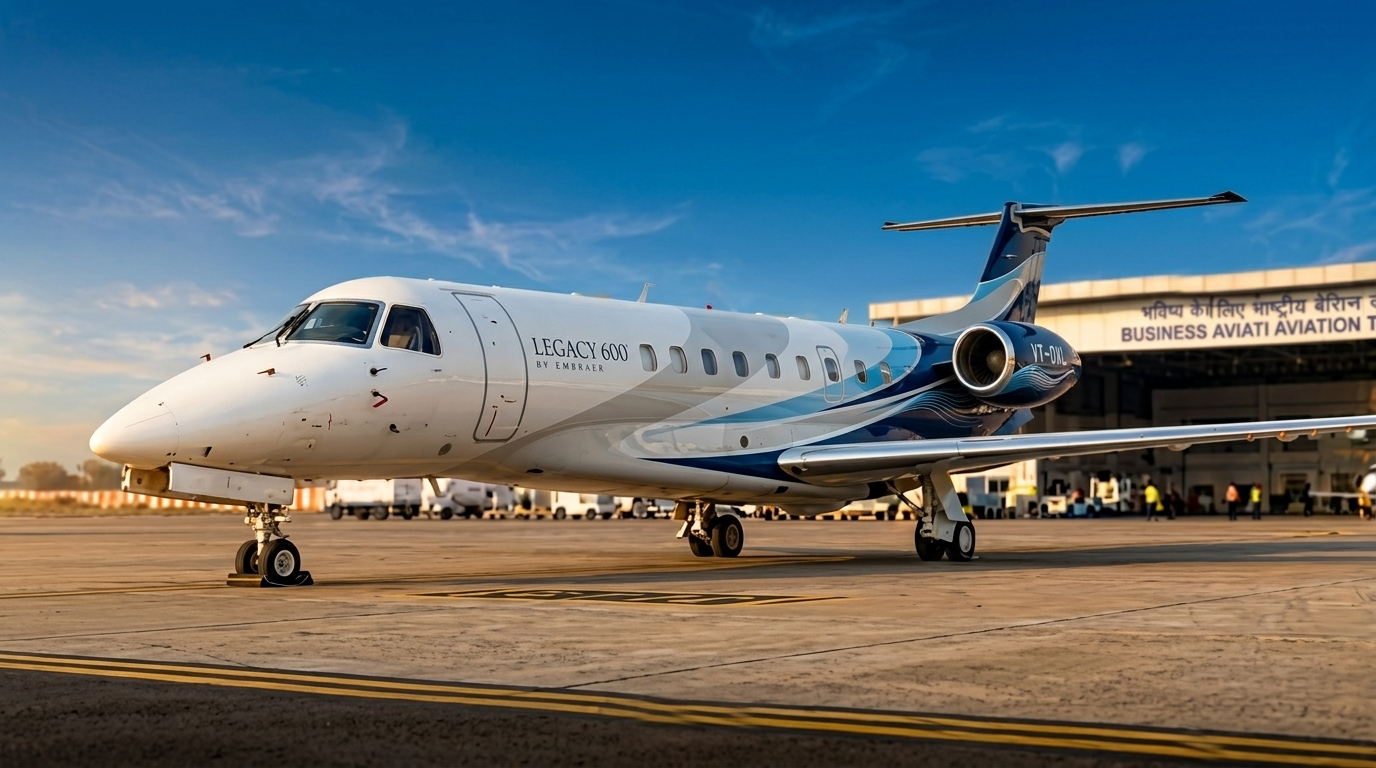
How does a private jet charter business make money in India? The short answer is that it sells reliable access to an aircraft at a price higher than the full cost of operating the trip. However, sustainable profit for a private jet charter business in India rarely comes from hourly charter revenue alone. Strong operators combine charter sales with aircraft management, long-term corporate contracts, empty-leg monetisation, specialised missions and disciplined fleet utilisation.
The business depends on much more than owning an impressive aircraft. A jet can be a valuable asset when matched to demand, based in the right location and available for enough billable hours. It can become a costly liability when it sits idle, flies empty too often or serves unsuitable routes.
This guide explains exactly how does a private jet charter business make money in India, covering the business model, principal revenue streams, major costs, break-even logic and the operating indicators that investors and partners should examine.
Understanding how does a private jet charter business make money in India starts with the aircraft itself, utilisation, location, and route density all drive profitability.
Private Jet Charter Business Model in India: A Quick Overview
A private charter operator provides the entire aircraft for a specific journey rather than selling individual seats on a scheduled flight. The client is paying for control: departure timing, routing, privacy, baggage flexibility and access to airports that may not have a practical scheduled connection.
The commercial model can take several forms:
| Operating model | How revenue is earned | Main commercial risk |
|---|---|---|
| Owned-fleet charter | The operator owns or finances aircraft and sells charter missions | High fixed costs and asset exposure |
| Leased-fleet charter | Aircraft are leased and deployed for charter operations | Lease obligations continue during weak demand |
| Aircraft management | An owner appoints an operator to manage and commercially deploy the aircraft | Limited availability or owner-use conflicts |
| Charter brokerage | A broker sources aircraft from licensed operators and earns a commission or spread | Dependence on third-party availability and execution |
| Hybrid model | The company combines owned, leased and managed capacity | More operational complexity |
In India, commercial charter flying must operate within the applicable framework of the Ministry of Civil Aviation and the Directorate General of Civil Aviation (DGCA). A customer-facing brand, broker and aircraft operator are not automatically the same entity. Good governance should make those roles clear. Read more about how Air Kalinga structures its own DGCA-approved charter operations.
This distinction matters because it shapes exactly how does a private jet charter business makes money in India in practice. Revenue can be earned at the brand level, the brokerage level, or the operating level, and the most resilient companies understand which layer they are monetising at every stage of a transaction.
The 7 Ways a Private Jet Charter Business Makes Money in India
1. Selling Complete Charter Flights
The core revenue stream behind how a private jet charter business makes money in India is the sale of an aircraft for a mission. A quote usually reflects aircraft category, flight time, positioning, airport charges, crew requirements, ground handling, applicable taxes and the operational complexity of the itinerary.
Clients may include business owners, corporate leadership teams, public figures, sports and entertainment groups, pilgrimage organisers and families requiring privacy or schedule control. They are not simply buying luxury. They are often buying time, certainty, confidentiality and direct access. For a full breakdown of what drives charter pricing in India, see our companion guide on private jet charter cost in India.
The crucial metric is contribution per mission, not the headline charter price. The operator first deducts trip-related expenses such as fuel, airport charges, handling, crew travel and catering. The remaining contribution must help pay fixed expenses and ultimately produce profit.
An aircraft may generate high invoice value and still produce weak economics if it must fly a long empty sector to collect the passenger. Route density and aircraft location therefore matter almost as much as the hourly price.
2. Earning Aircraft Management Fees
Many high-net-worth individuals and companies own aircraft but do not want to build a complete operations department. A qualified operator can manage crew, maintenance coordination, regulatory records, scheduling, hangar arrangements and day-to-day readiness for a recurring fee.
The agreement may also permit third-party charter when the owner is not using the aircraft. This can offset part of the ownership cost while giving the operator marketable capacity without buying the asset.
The contract must define availability, owner priority, revenue sharing, maintenance responsibility and approval rules. Poorly designed agreements create disputes precisely when demand is strongest. A well-designed management portfolio, however, can add recurring income and expand fleet choice with less capital than an entirely owned fleet.
3. Securing Corporate and Institutional Contracts
Occasional charter bookings can be valuable but unpredictable. Corporate flight agreements, retainers and contracted flying programmes improve demand visibility, and are one of the more stable answers to how does a private jet charter business make money in India over multiple years rather than mission by mission.
A company may reserve capacity for leadership travel, plant visits, project teams or emergency movement between cities with weak scheduled connectivity. Event companies, government-approved users, medical coordinators and specialist logistics providers can also require repeat capacity.
Contracted demand helps plan crew rosters, maintenance and aircraft allocation. It can also reduce acquisition costs and create a stable base around which higher-yield missions are scheduled.
Operators should still protect the value of scarce capacity. A poorly priced contract that blocks an aircraft during peak periods can reduce overall profitability. Minimum commitments, cancellation terms, waiting charges and peak-period rules should be commercially explicit.
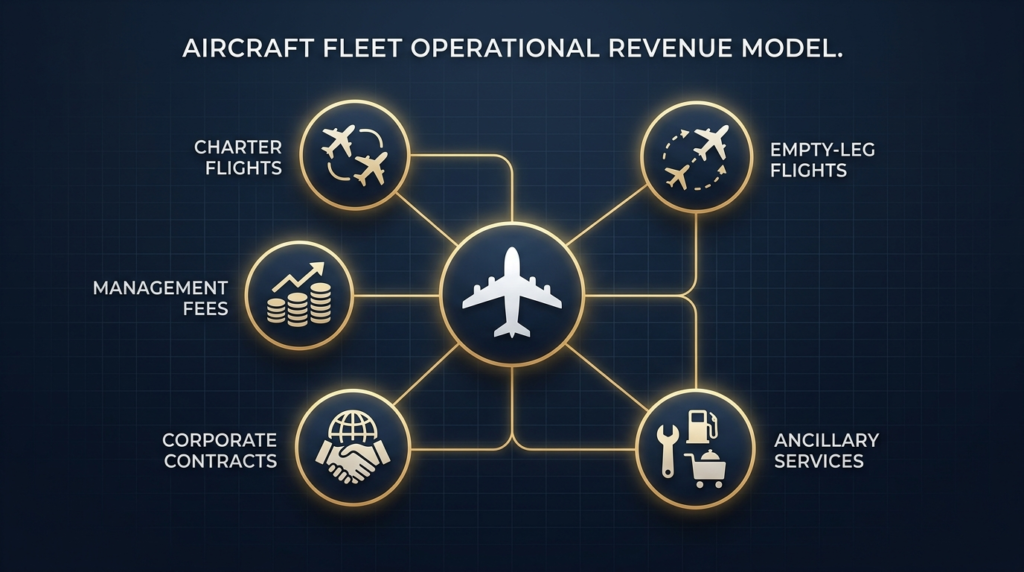
A private jet charter business in India earns revenue through multiple overlapping streams, not charter sales alone.
4. Monetising Empty-Leg Flights
An empty leg occurs when an aircraft must reposition without the original paying passenger. For example, an aircraft may fly from its base to another city to begin a charter or return after completing a one-way booking.
Selling that empty sector at a reduced price creates incremental revenue from a movement that may have occurred anyway. This can improve the economics of the overall rotation, but empty legs are not guaranteed products. Their timing and routing depend on another confirmed mission and may change if that mission changes.
The better strategic goal is to reduce avoidable positioning through network planning. Demand data, base selection, broker relationships and back-to-back scheduling can help match one client’s arrival city with another client’s departure requirement.
Empty-leg sales are useful, but they do not magically turn every unproductive flight into profit. The strongest operators treat them as inventory optimisation rather than as the foundation of the business.
5. Operating Specialised and Urgent Missions
Some customers pay for a capability that scheduled airlines cannot provide easily. Relevant missions may include urgent corporate travel, remote-site access, election or campaign movement, religious group travel, time-critical personnel deployment and medical transport through appropriately equipped and authorised providers, such as the air ambulance service Air Kalinga operates across Odisha.
These assignments can command higher value because they require rapid response, complex coordination or specialised equipment. They may also carry higher costs and operating risk. Medical missions, for instance, require more than an aircraft and an available slot; they require the correct clinical partners, equipment, permissions and ground-transfer coordination.
Profit comes from dependable execution, not from attaching a premium label to the mission. Operators that develop repeatable procedures and credible partner networks can build defensible expertise in selected categories.
6. Providing Ancillary Aviation Services
A charter platform may earn additional revenue from services surrounding the flight. Depending on its licences, capabilities and partner structure, these can include ground handling coordination, flight support, hangar facilitation, maintenance coordination, crew services, concierge logistics and charter brokerage.
These services can increase revenue per client and diversify income during aircraft maintenance. Each service still needs a clear scope, responsible entity and commercial model. Passing through a third-party cost is not the same as earning a healthy margin.
The best ancillary services solve genuine friction: obtaining a suitable aircraft quickly, coordinating a multi-city itinerary, arranging secure ground movement or keeping an owner aircraft mission-ready.
7. Building a Balanced Fleet and Partner Network
No single aircraft is ideal for every mission. A turboprop may be efficient for a shorter regional route, while a light or midsize jet may be more appropriate for speed, range, passenger count or customer preference. Deploying an unnecessarily large aircraft raises trip cost; offering one that is too small may make the mission impossible or unattractive.
A balanced combination of controlled aircraft and vetted partner capacity allows a charter operator to serve more requests without owning every asset. This model can earn brokerage or management income while preserving owned or leased aircraft for missions where they have the strongest contribution.
The commercial advantage comes from matching the right aircraft to the right mission, not from claiming the largest possible fleet. See Air Kalinga’s current fleet for an example of how aircraft category is matched to mission type.
What Are the Major Costs of Running a Private Jet Charter Business in India?
To understand how does a private jet charter business make money in India, separate costs into fixed, variable and semi-variable categories.
Fixed and Committed Costs
These costs continue even when the aircraft is not carrying a paying passenger:
- Aircraft lease, loan or capital cost
- Salaried flight crew and operations staff
- Insurance
- Hangar or parking arrangements
- Regulatory compliance and audit systems
- Software, dispatch and administrative infrastructure
- Training and recurrent qualification programmes
Variable Mission Costs
These rise when the aircraft flies:
- Aviation turbine fuel
- Airport, navigation and ground-handling charges
- Maintenance reserves linked to hours or cycles
- Crew travel and accommodation
- Catering and passenger-specific services
- De-icing, permits or overseas support, where applicable
Semi-Variable Costs
Maintenance, staffing and sales expenditure do not always move neatly with each flight. An additional aircraft may require another crew set. A major maintenance event can remove capacity and create a large cash requirement. Customer acquisition may rise before revenue follows.
This is why an operator cannot calculate margin by subtracting fuel alone from the charter price. Full economics must recognise aircraft ownership or lease costs, maintenance exposure, unproductive flying and organisational overhead, and this full-cost view is the only honest way to answer how does a private jet charter business make money in India over the long term.

Fleet utilisation, not fleet size, is the strongest predictor of profitability for any charter business in India.
Why Fleet Utilisation Determines Profitability
Fleet utilisation measures how effectively an aircraft is deployed. Operators commonly monitor billable flying hours, total flying hours, occupied sectors, empty sectors, aircraft availability and maintenance downtime.
The central tension is simple: the aircraft must fly enough revenue-generating missions to absorb fixed costs, but growth cannot compromise maintenance discipline, crew duty limits or operational resilience.
Three aircraft can generate the same number of flight hours and produce very different results:
- Aircraft A flies frequent paid missions from its home base.
- Aircraft B records similar hours but spends a large share repositioning empty.
- Aircraft C earns a high charter rate but loses availability to maintenance and poor scheduling.
Aircraft A is likely to create the strongest contribution because more of its movement is productive. Headline hours alone are therefore not enough. Investors should ask how many hours were billable, what the realised yield was and what it cost to create those hours.
How Is Charter-Flight Profit Calculated?
A simplified mission formula is:
Mission contribution = Charter revenue − direct trip costs − allocated positioning costs
At the fleet level:
Operating result = Total mission contribution + management and service income − fixed operating costs − corporate overhead
Consider a hypothetical round trip. The client quote includes two passenger sectors, but the aircraft must first reposition to the departure city. The operator should evaluate revenue against fuel, airport charges, handling, crew costs, maintenance reserves and that positioning sector. Only the remaining contribution is available to absorb monthly fixed costs.
The break-even point can be expressed as:
Break-even billable hours = Monthly fixed costs ÷ Average contribution per billable hour
This formula is useful but should not be treated as a promise. Contribution varies by route, aircraft, season, passenger requirements and empty-flying pattern. A serious business plan models several demand and cost scenarios rather than presenting one optimistic break-even number.
What Improves the Profit Margin of an Indian Charter Operator?
Increase Productive Flying, Not Simply Total Flying
Revenue hours matter more than aircraft movement. Better scheduling, sensible bases and route matching can reduce empty positioning.
Improve Realised Yield
The quoted hourly rate is not always the realised yield after discounts, commissions and exceptions. Pricing should reflect mission complexity, scarce capacity and the complete rotation.
Select Aircraft Around Actual Demand
Fleet decisions should begin with mission data: common routes, passenger counts, runway requirements, baggage, range and willingness to pay. Buying an aircraft first and searching for demand later reverses the logic.
Control Downtime
Preventive planning, spare-part coordination and strong maintenance relationships protect availability. Safety and airworthiness remain non-negotiable; the commercial objective is predictable maintenance rather than deferred maintenance.
Diversify Revenue Carefully
Management contracts, corporate agreements and support services can smooth volatility. Diversification helps only when each service is competently delivered and properly priced.
Build Direct Customer Relationships
Brokers are important distribution partners, especially for unfamiliar markets or short-notice demand. Direct repeat clients can nevertheless lower acquisition cost and improve itinerary knowledge. A balanced channel mix reduces dependence on any single source.
Key Metrics Investors Should Examine
Investors evaluating how a private jet charter business makes money in India should request operational evidence, not just market-size forecasts.
| Metric | What it reveals |
|---|---|
| Billable hours per available aircraft | Productive fleet utilisation |
| Revenue per billable hour | Pricing and mission mix |
| Contribution per mission | Value remaining after direct costs |
| Empty-flight ratio | Network and scheduling efficiency |
| Technical dispatch reliability | Operational readiness |
| Maintenance downtime | Lost availability and planning quality |
| Repeat-client share | Customer satisfaction and revenue durability |
| Contracted versus ad hoc revenue | Demand visibility |
| Customer concentration | Dependence on a small number of buyers |
| Cash conversion and receivables | Whether accounting revenue becomes cash |
Governance matters as much as fleet size. Investors should understand which entity holds operational responsibility, who owns or leases each aircraft, how related-party transactions are priced, how maintenance reserves are funded and how safety performance is monitored.
Risks That Can Weaken Charter Profitability
The model is exposed to fuel-price movement, foreign-exchange effects, maintenance events, limited aircraft availability, crew constraints, seasonal demand and regulatory change. A single aircraft business also faces concentration risk: scheduled maintenance or an unexpected technical issue can interrupt almost all revenue.
Aggressive discounting creates another trap. A flight can generate cash while failing to cover its true economic cost. Similarly, rapid fleet expansion may increase revenue but weaken cash flow if aircraft are added before dependable demand is secured.
The most resilient businesses maintain liquidity, diversify capacity, document operational controls and make growth decisions from route-level contribution data.
Is a Private Jet Charter Business Profitable in India?
Yes, a private jet charter business can be profitable in India, but profitability is not automatic. It depends on productive utilisation, disciplined pricing, controlled empty flying, reliable aircraft availability and an appropriate mix of charter and recurring service revenue.
India offers a persuasive use case for private aviation: long travel distances, expanding commercial centres, industrial locations outside major metros and customers for whom schedule certainty has substantial value. Yet attractive demand does not rescue a weak operating model. The winning operator converts that demand into repeatable missions while protecting safety, compliance and cash.
For clients, this produces dependable access. For aircraft owners, it can offset ownership costs. For investors, the opportunity lies in a governed aviation platform whose growth can be measured through utilisation, contribution and recurring relationships, not merely through the number of aircraft displayed on a website.
Frequently Asked Questions
How does a private jet charter business make money in India?
A private jet charter business makes money in India from complete aircraft bookings, aircraft management fees, corporate contracts, empty-leg sales, specialised missions, brokerage and related flight-support services. Profit is created when the contribution from these activities exceeds aircraft, staff, maintenance, compliance and overhead costs.
What is the biggest driver of charter profitability?
Productive fleet utilisation is usually the central driver. An aircraft must generate enough well-priced, billable flying to absorb fixed costs. Empty positioning, downtime and weak pricing can undermine profitability even when total flight hours appear healthy.
Does a charter company need to own every aircraft it offers?
No. A business may combine owned, leased and managed aircraft with capacity sourced from appropriately authorised partner operators. The customer should be told clearly which entity operates the flight and holds operational responsibility.
How do empty-leg flights generate revenue?
An empty leg is a repositioning sector without the original paying client. Selling seats or the aircraft for that existing sector can create incremental revenue, although its schedule depends on the associated confirmed mission.
What should investors check before investing in a charter company?
Investors should examine billable utilisation, contribution per mission, empty-flying ratio, maintenance downtime, repeat customers, contracted revenue, cash flow, fleet ownership or lease terms, regulatory standing and safety governance.
Is aircraft ownership necessary for strong margins?
Not necessarily. Ownership offers asset control but creates capital and residual-value exposure. Management and hybrid models can expand capacity with less asset ownership, although contracts and availability must be managed carefully.
Who regulates commercial charter aviation in India?
The Ministry of Civil Aviation sets policy, while the Directorate General of Civil Aviation performs key safety and regulatory functions. Operators must comply with the approvals and requirements applicable to their aircraft and operations.
Conclusion
So, how does a private jet charter business make money in India? It turns scarce aircraft availability, operational capability and time-saving access into well-priced missions, then improves the economics through management income, contracts, specialised services and intelligent fleet deployment.
The decisive factors are not glamour or fleet announcements. They are billable utilisation, route-level contribution, aircraft reliability, disciplined capital allocation and transparent governance. A charter business that measures those fundamentals can build a scalable aviation business; one that ignores them may increase activity without creating durable profit.
Air Kalinga is building an aviation platform focused on operational clarity, regional connectivity and dependable charter solutions. To discuss charter requirements, aircraft partnerships or strategic collaboration, contact the Air Kalinga team.
Aviation Services & Planning
Air Kalinga offers bespoke aviation solutions tailored around efficiency, safety, and luxury. Discover our on-demand Private Jet Charter in Odisha, 24/7 Air Ambulance Services in Odisha, explore our executive aircraft fleet, or contact our flight desk to schedule your flight.
Related Journal Reading: Private Jet Charter for Industrial Site Visits India: 7 Powerful Advantages